
About Course
Comprehensive CPR Training: HLTAID009 Provide Cardiopulmonary Resuscitation in Brisbane, QLD
Knowing how to perform CPR can mean the difference between life and death in an emergency. Our CPR Training Brisbane, QLD course at NSTA Hillcrest™ is designed to provide you with the confidence and practical skills needed to respond to cardiac emergencies effectively. The HLTAID009 Provide Cardiopulmonary Resuscitation course covers critical life-saving techniques, including chest compressions, rescue breaths, and the use of an Automated External Defibrillator (AED).
Whether you are a healthcare professional, workplace safety officer, or simply someone who wants to be prepared for emergencies, this nationally recognised training is essential.
Unlock the power of life-saving skills with the HLTAID009 Provide Cardiopulmonary Resuscitation in Brisbane, Gold Coast, Sunshine Coast and Surrounds at NSTA Hillcrest.
This comprehensive course is designed to equip you with the essential skills and knowledge required to perform CPR in accordance with the Australian Resuscitation Council (ARC) guidelines.
Quick Facts — HLTAID009 (Brisbane, QLD)
✔ Unit code & title: HLTAID009 Provide Cardiopulmonary Resuscitation
✔ Delivery: Blended (e-Learning + Face-to-Face) at NSTA Hillcrest
✔ Assessment: Written, practical, and scenario-based
Course Overview
This unit describes the skills and knowledge required to perform cardiopulmonary resuscitation (CPR) in line with the ARC guidelines.
It applies to all persons who may be required to provide CPR in a range of situations, including community and workplace settings.
Specific licensing/regulatory requirements relating to this competency, including requirements for refresher training, should be obtained from the relevant Work Health and Safety Regulatory Authorities.
Mapping
✔ HLTAID009 Provide Cardiopulmonary Resuscitation (Supersedes HLTAID001)
Application
This unit describes the skills and knowledge required to provide a first aid response to a casualty in line with first aid guidelines determined by the Australian Resuscitation Council (ARC) and other Australian national peak clinical bodies.
The unit applies to all persons who may be required to provide a first aid response in a range of situations, including community and workplace settings.
Specific licensing/regulatory requirements relating to this competency, including requirements for refresher training should be obtained from the relevant national/state/territory Work Health and Safety Regulatory Authorities.
This course is appropriate for experienced first aiders and people who complete their training regularly.
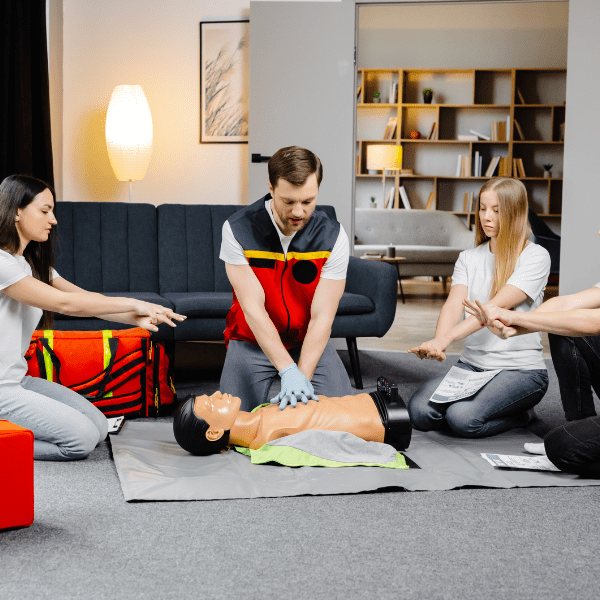
Assessment is through a combination of practical first aid activities and a written test paper. You will be required to demonstrate CPR on a manikin on the floor.
Elements and Performance Criteria: –
Elements describe the essential outcomes Performance criteria describe the performance needed to demonstrate achievement of the element.
Respond to an emergency situation.
✔ 1.1. Recognise and assess an emergency situation.
✔ 1.2. Ensure safety for self, bystanders and casualty.
✔ 1.3. Assess the casualty and recognise the need for first aid response.
✔ 1.4. Seek assistance from emergency services.
Apply appropriate first aid procedures.
✔ 2.1. Perform cardiopulmonary resuscitation (CPR) in accordance ARC guidelines.
✔ 2.2. Provide first aid in accordance with established first aid principles.
✔ 2.3. Display respectful behaviour towards casualty.
✔ 2.4. Obtain consent from casualty where possible.
✔ 2.5. Use available resources and equipment to make the casualty as comfortable as possible.
✔ 2.6. Operate first aid equipment according to manufacturers’ instructions.
✔ 2.7. Monitor the casualty’s condition and respond in accordance with first aid principles.
Communicate details of the incident.
✔ 3.1. Accurately convey incident details to emergency services.
✔ 3.2. Report details of incident in line with appropriate workplace or site procedures.
✔ 3.3. Complete applicable workplace or site documentation, including incident report form.
✔ 3.4. Maintain privacy and confidentiality of information in line with statutory or organisational policies.
Review the incident.
✔ 4.1. Recognise the possible psychological impacts on self and other rescuers and seek help when required.
✔ 4.2. Contribute to a review of the first aid response as required.
Foundation Skills :
The Foundation Skills describe those required skills (language, literacy, numeracy and employment skills) that are essential to performance.
Foundation skills essential to performance are explicit in the performance criteria of this unit of competency.
Knowledge Evidence :
Demonstrated knowledge required to complete the tasks outlined in elements and performance criteria of this unit:
Guidelines and procedures including:
✔ ARC guidelines relevant to the provision of first aid
✔ First aid guidelines from Australian national peak clinical bodies
✔ Potential incident hazards and risk minimisation processes when providing first aid
✔ Infection control procedures, including use of standard precautions and resuscitation barrier devices
✔ Requirements for currency of skill and knowledge
✔ First aid codes of practice
✔ Appropriate workplace or site procedures relevant to the provision of first aid
✔ Contents of first aid kits
Legal, workplace and community considerations including:
✔ Duty of care requirements
✔ Own skills and limitations
✔ Consent and how it relates to the conscious and unconscious casualty
✔ Privacy and confidentiality requirements
✔ Awareness of potential need for stress management techniques and available support for rescuers
Considerations when providing CPR, including:
✔ Upper airway and effect of positional change
✔ Appropriate duration and cessation of CPR
✔ Appropriate use of an AED
✔ Safety and maintenance procedures for an AED
✔ Chain of survival
✔ How to access emergency services
Techniques for providing CPR to adults, children and infants including:
✔ How to recognise that a casualty is unconscious and not breathing normally
✔ Rate, ratio and depth of compressions and ventilations
✔ Correct hand positioning for compressions
✔ Basic anatomy, physiology and the differences between adults, children and infants relating to CPR
Signs, symptoms and management of the following conditions and injuries:
✔ Allergic reaction
✔ Anaphylaxis
✔ Asthma
✔ Non-life-threatening and life-threatening bleeding
✔ Burns
✔ Cardiac conditions, including chest pain
✔ Choking
✔ Diabetes
✔ Drowning
✔ Envenomation – all current treatments
✔ Eye injuries
✔ Fractures, dislocations, strains and sprains
✔ Head, neck and spinal injuries
✔ Hypothermia
✔ Hyperthermia
✔ Minor wounds
✔ Nose-bleed
✔ Poisoning
✔ Seizures
✔ Shock
✔ Sharps injuries
✔ Stroke
Performance Evidence :
Evidence of the ability to complete tasks outlined in elements and performance criteria of this unit in the context of the workplace or community setting.
There must be evidence that the candidate has completed the following tasks in line with State/Territory regulations, first aid codes of practice, first aid guidelines determined by the Australian Resuscitation Council (ARC) and other Australian national peak clinical bodies and workplace or site procedures:
✔ Managed, in line with ARC guidelines, the unconscious, breathing casualty including appropriate positioning to reduce the risk of airway compromise
✔ Managed, in line with ARC guidelines, the unconscious, non-breathing adult, including:
✔ Performing at least 2 minutes of uninterrupted single rescuer cardiopulmonary resuscitation (CPR) (5 cycles of both compressions and ventilations) on an adult resuscitation manikin placed on the floor
✔ Following the prompts of an automated external defibrillator (AED) to deliver at least one shock
✔ Demonstrating a rotation of single rescuer operators with minimal interruptions to compressions
✔ Responding appropriately in the event of regurgitation or vomiting
✔ Managed, in line with ARC guidelines, the unconscious, non-breathing infant, including:
✔ Performing at least 2 minutes of uninterrupted single rescuer CPR (5 cycles both compressions and ventilations) on an infant resuscitation manikin placed on a firm surface
Managed casualties, with the following:
✔ Anaphylaxis
✔ Asthma
✔ Non-life-threatening bleeding
✔ Choking
✔ Envenomation, using pressure immobilisation
✔ Fractures, dislocations, sprains and strains, using appropriate immobilisation techniques
✔ Minor wound cleaning and dressing
✔ Nosebleed
✔ Shock
Responded to at least one simulated first aid incident contextualised to the candidate’s workplace or community setting, where the candidate has no knowledge of the casualty’s condition prior to starting treatment, including:
✔ Identifying the casualty’s illness or injury through history, signs and symptoms
✔ Using personal protective equipment (PPE) as required
✔ Providing appropriate first aid treatment
✔ Conveying incident details to emergency services or advising casualty on any required post incident action
✔ Providing an accurate verbal and written report of the incident
✔ Reviewing the incident.
Assessment Conditions :
Each candidate to demonstrate skills in an environment that provides realistic in-depth, scenarios and simulations to assess candidates’ skills and knowledge.
Due to the nature of this type of training, it is acceptable for the performance evidence to be collected in a simulated environment.
Compression and ventilation skills must be demonstrated on resuscitation manikins following ARC guidelines for the purpose of assessment of CPR procedures.
Course Outline
✔ Roles and responsibilities of the first aider
✔ The DRSABCD action plan and responding to emergency situations
✔ Managing unconscious casualties
✔ Cardiopulmonary resuscitation (CPR)
✔ Using a defibrillator (AED)
✔ Legal issues in first aid
✔ Infection control
✔ Diabetes
✔ Heart attack
✔ Asthma
✔ Anaphylaxis
✔ Wound and bleeding management
✔ Burns
✔ Fractures and dislocations
✔ Sprains and strains
✔ Head and facial injuries
✔ Spinal injuries
✔ Medical emergencies
✔ Choking
✔ Abdominal and chest injuries
✔ Heat and cold induced conditions
✔ Poisoning management
✔ Bites and stings
✔ Stroke
Assessment must ensure access to:
✔ Adult and infant resuscitation manikins following ARC guidelines for the purpose of assessment of CPR procedures
✔ Adrenaline auto-injector training device
✔ AED training devices
✔ Workplace first aid kit
✔ Placebo bronchodilator and spacer device
✔ Different types of wound dressings and bandages
✔ Blankets and items to treat for shock
✔ Personal protective equipment (PPE)
✔ Workplace injury, trauma or illness record, or other applicable workplace or site incident report form.
Simulated assessment environments must simulate real-life situations where these skills and knowledge would be performed, with all the relevant equipment and resources of that workplace or community environment.
Course Details: HLTAID009 Provide Cardiopulmonary Resuscitation
✔ Course Code: HLTAID009
✔ Course Title: Provide Cardiopulmonary Resuscitation
✔ Mode of Delivery: Blended (e-Learning + Face-to-Face)
✔ Assessment: Written, practical, and scenario-based
✔ Minimum Age: 14 years
✔ Certificate Validity: 12 months (annual renewal recommended)
Why Choose NSTA Hillcrest?
✔ Nationally recognised training delivered on behalf of NSTA Pty Ltd (RTO 32292)
✔ Trainers with current, real-world first aid experience
✔ Blended learning for convenience and strong practical confidence
✔ Convenient Hillcrest location for Brisbane, Gold Coast, Sunshine Coast and surrounds
RPL & Credit Transfer — HLTAID009
✔ Credit Transfer: available if you already hold HLTAID009 from another RTO (same unit code).
✔ RPL: limited for CPR — you’ll still need to demonstrate current practical skills (e.g., floor-based CPR).
✔ Contact NSTA Hillcrest for evidence requirements and timelines.
Ready to Refresh or Gain Your CPR Skills?
Speak with NSTA Hillcrest about HLTAID009 Provide Cardiopulmonary Resuscitation schedules and enrolment.
📞 Phone: 07 3800 8631
📧 Email: hillcrest@nsta.edu.au
📍 Location: 18 Elliott Court, Hillcrest, QLD 4118
🌐 Website: hillcrest.nsta.edu.au
Frequently Asked Questions – HLTAID009 Provide Cardiopulmonary Resuscitation (QLD)
📞 Phone: 07 3800 8631
📧 Email: hillcrest@nsta.edu.au
📍 Address: 18 Elliott Court, Hillcrest, QLD 4118
🌐 Website: hillcrest.nsta.edu.au
